


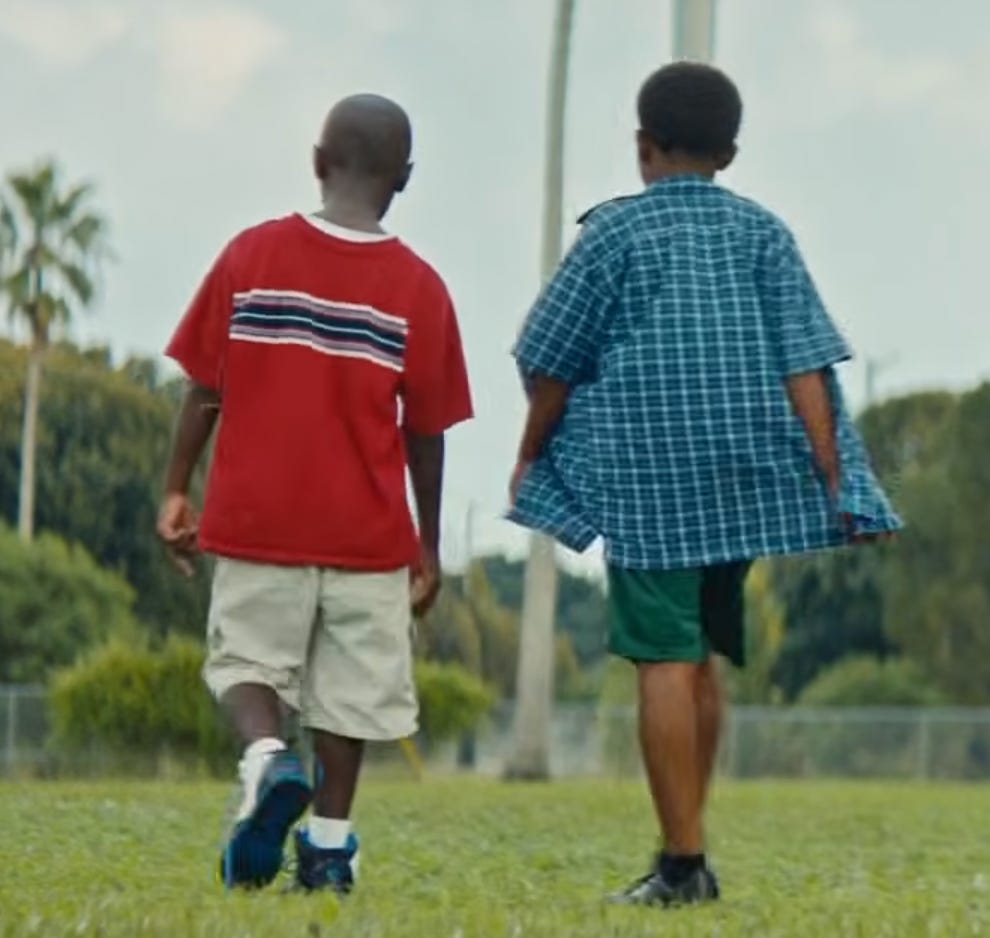
My seven year old son is very tall for his age, very fast, and has good hand-eye-coordination. We’ve put him in multiple sports—basketball, baseball, soccer, and flag football so far—and his attributes are enough, at his age level, to distinguish him from most of his peers. I am not certain if he likes sports (or a particular sport) enough yet to put in the hours of work necessary to continue to be good. We’ll see. I do know that he enjoys the social and emotional validation he’s received from being what’s considered to be good for his age at everything he tries right now.
Yesterday, he expressed a desire to play tackle football. It was not the first time he’s asked me, and I don’t know how sincere this desire is. (He has also, at various times over the past year, asked to play tennis, volleyball, golf, hockey, rugby, and American Ninja Warrior.) But how badly my son wants to play is inconsequential. Because my answer will always be no.
My rationale is based on information we’ve learned about the long-term impact of repeated collisions on the brain. Of course, each sport involves physical risk. But the chance of irreversible brain injury while playing tackle football is too high for me to allow my son to play. It does not matter to me that my parents allowed me to play, and that I managed to leave the sport with no chronic aliments. There’s more information about this available to me than was available to my parents. My choice for him reflects that change
But—and this is where it gets messy—it’s not all about the risk to him. I also don’t want to be seen as the type of parent who’d allow their son to play tackle football in 2026. That—and what it would communicate about me—matters to me too. It just fortunate for me that my ideology happens to be aligned with the decision most middle class parents are making today, and that there’s minimal social risk to opting out.
The most fascinating responses I’ve seen to Nikole Hannah-Jones’s New York Times Magazine story on the decisions she’s made about her daughter’s schooling are from people who’ve put themselves in these bizarre and sanctimonious logical pretzels, where Nikole’s choices are seen as both unusually ideological and unusually selfish. Which is just so odd for me to read, because to reiterate a point from Nate Marshall, everything a parent does is ideological.
Just the decision to have kids is ideological. When you decide to have kids is ideological. The type of family you decide to create is ideological. Where you decide to live is ideological. What food you feed your children is ideological. Each choice you make is a reflection of how you wish to exist in the world, which is a reflection of your core values and beliefs. Sometimes those choices have tremendous risks on your children. I have chosen to live in Pittsburgh instead of a city with more Black people, because I am from here and also because Pittsburgh’s cost of living allows me a lifestyle I wouldn’t be able to afford right now in Washington, DC, New York City, Philadelphia and other attractive and geographically close major cities. Will that choice impact my kids? Of course it will! What impact has it had? Don’t know yet!
I waited until my mid 30s to start a family. Is it better for my kids that I waited until I was more established financially to have them? Or would it have been better for their longterm well-being to have a younger and more energetic dad? The answer to both questions is Maybe!?!? I’ve chosen to live in the city (where schools are a crapshoot) instead of a high-ranking suburb—another personal choice that affects my children. Am I sacrificing them? No! I believe that the benefits of living in the city, and my wife and I’s ability to supplement any deficits in their education, are preferable to the benefits of living in the suburbs. But, I might be wrong!
And I think it’s impossible to overstate how prominently “But, I might be wrong!” exists in a parents’ consciousness. Sometimes in our nightmares. I’ve been alive for 47 years. A dad though for only 10. While all of the reading and researching and observing definitely helps, sometimes parenting is just trial and error, where you make a hard choice and cross your fingers that it doesn’t put your kid in therapy. Some decisions, like choosing not to vaccinate your children, are objectively dangerous and bad. Most others are “ehhh—I guess we’ll see!”
There is, of course, space to question Nikole’s ideology and the choices she made. She was the very first guest on my podcast, and I brought her on specifically to do that. My kids were much younger then, and the show was split into two conversations—one with her, and one with my dad—to help me think through the decisions I’d have to make, and the “why” inside each choice. But the critique of her as a bad and uncaring mom seems to be coming from two places. Either people unaware of or uncaring about the reality that Black parents are routinely forced to make impossible choices. Or people who just don’t like her, and are trying (very unsuccessfully) to perform a sober objectivity while presuming her choices came from a self-centered and myopic neglect.
And it’s fine not to like people! It’s fine even to allow your personal feelings to dictate whether you give someone the benefit of the doubt. But just, maybe, admit that! Just as I’ll admit that Nikole is a friend. We’ve known each other for a decade. We’ve done events together. I’ve been in her house. We hung out just last week. I am not objective here. Not just because I know her, though. But because I’m willing to give the benefit of the doubt to any Black parent trying their fucking best to navigate the booby-trapped labyrinth of raising a healthy and happy and conscientious Black child in this country.
I've seen a couple opinions that she "coopted a struggle," but that's literally, historically the only way that systems have changed in this country! Someone who "didn't have to," did. And someone in a position of power was so offended by that experience, they decided to do something about it.
...and I think we should all embody our principles to the point of taking calculated risks...the problem is most of us are waiting for someone else to do it (whatever it is).
And I love that her practice is radical enough to have done so 🤷🏾♀️
Amen. Amen. Amen.